
Download links
How to install The Science of Bouncing Ball Dynamics APK?
1. Tap the downloaded The Science of Bouncing Ball Dynamics APK file.
2. Touch install.
3. Follow the steps on the screen.
Description
The dynamics of a bouncing ball is a fascinating intersection of physics, material science, and engineering principles. At first glance, the simple act of a ball bouncing off a surface may seem trivial, yet it encapsulates a wealth of complex interactions between forces, energy transformations, and material behaviors. Understanding these dynamics not only enhances our comprehension of basic physical principles but also has practical implications across various fields, including sports, engineering, and even robotics.
The study of bouncing balls can reveal insights into energy conservation, momentum transfer, and the effects of different materials and surfaces on motion. As we delve into the intricacies of bouncing ball dynamics, we will explore the fundamental physics that govern this phenomenon. We will examine how various factors influence the behavior of a bouncing ball, from the properties of the ball itself to the characteristics of the surface it interacts with.
Additionally, we will discuss the mathematical models that describe the trajectory of a bouncing ball and highlight real-world applications in sports and engineering.
Key Takeaways
- Bouncing ball dynamics involve the study of the behavior of balls when they are dropped or thrown onto a surface.
- The physics of bouncing balls is influenced by factors such as the material properties of the ball, the surface conditions, and the angle and velocity of impact.
- Material properties such as elasticity, density, and surface texture play a significant role in determining the behavior of bouncing balls.
- Surface conditions, including roughness, softness, and angle, can greatly affect the trajectory and behavior of bouncing balls.
- The mathematics of bouncing ball trajectory involves the study of equations and principles that govern the motion and path of bouncing balls.
The Physics of Bouncing Balls
At the core of bouncing ball dynamics lies the fundamental principles of physics, particularly Newton’s laws of motion. When a ball is dropped from a height, it accelerates towards the ground due to gravity. Upon impact with a surface, several forces come into play: gravitational force, normal force, and frictional force.
The interaction between these forces determines how high the ball will bounce and how much energy is lost during the collision. The coefficient of restitution, a key parameter in this context, quantifies the elasticity of the collision. It is defined as the ratio of the relative speed after the collision to the relative speed before the collision.
In an ideal scenario where no energy is lost to heat or sound, a perfectly elastic collision would result in the ball rebounding to its original height. However, real-world conditions often lead to energy dissipation through deformation of the ball and surface, air resistance, and other factors. The energy transformation during a bounce can be described using kinetic and potential energy equations.
This interplay between potential and kinetic energy is crucial for understanding how different balls behave when dropped from various heights.
Factors Affecting Bouncing Ball Dynamics
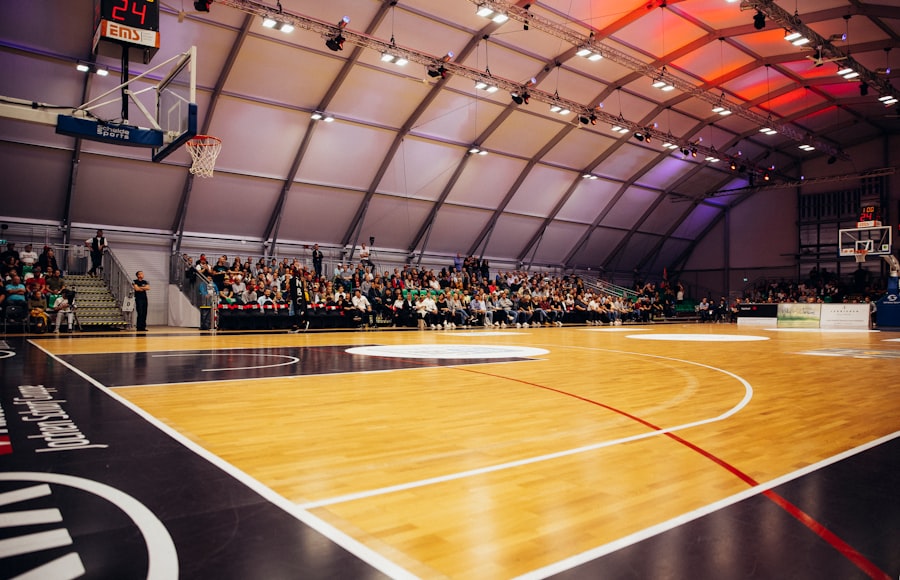
Several factors influence how a ball bounces, including its mass, shape, size, and internal pressure. A heavier ball will generally have more momentum than a lighter one when dropped from the same height, which can affect its bounce height and duration of contact with the surface. Additionally, the shape of the ball plays a significant role; for instance, a perfectly spherical ball will bounce differently than an oblong or irregularly shaped object due to variations in how they distribute forces upon impact.
Internal pressure is another critical factor that affects bouncing dynamics. A ball that is inflated to a higher pressure will typically bounce higher than one that is under-inflated. This is because increased internal pressure allows for greater deformation upon impact and quicker recovery to its original shape, thus facilitating a more efficient transfer of energy back into kinetic motion. Furthermore, temperature can also affect internal pressure; as temperature rises, so does pressure within an inflatable ball, which can enhance its bouncing capabilities.
The Role of Material Properties in Bouncing Ball Dynamics
| Material Property | Impact on Bouncing Ball Dynamics |
|---|---|
| Elasticity | Higher elasticity results in higher bounce height |
| Surface Texture | Smoother surfaces result in more predictable bounces |
| Density | Higher density leads to lower bounce height |
| Temperature | Colder temperatures can reduce bounce height due to decreased elasticity |
The materials used in constructing a ball significantly influence its bouncing behavior. Common materials include rubber, plastic, and composite materials, each exhibiting unique properties that affect elasticity and energy absorption. For example, rubber balls are known for their high elasticity and ability to deform upon impact while quickly returning to their original shape.
This characteristic allows them to maintain a higher coefficient of restitution compared to balls made from less elastic materials. Moreover, the hardness or softness of a material can dictate how much energy is absorbed during a bounce. Softer materials tend to absorb more energy upon impact, resulting in lower bounce heights.
Conversely, harder materials may not deform as much and can transfer more energy back into motion. The choice of material is particularly important in sports equipment design; for instance, basketballs are typically made from rubber or synthetic composites that provide optimal bounce characteristics while ensuring durability and performance on various surfaces.
The Influence of Surface Conditions on Bouncing Ball Dynamics
The surface on which a ball bounces plays an equally critical role in determining its dynamics. Different surfaces—such as grass, concrete, wood, or synthetic turf—exhibit varying degrees of hardness and frictional properties that can significantly affect how a ball behaves upon impact. A hard surface like concrete will generally provide a higher bounce compared to a softer surface like grass or sand due to less energy absorption during the collision.
Friction also influences how far a ball travels after it bounces. On surfaces with high friction coefficients, such as grass or carpet, a ball may lose speed quickly after bouncing due to increased resistance. In contrast, on smoother surfaces like polished wood or ice, a ball may continue to roll for longer distances after bouncing due to reduced frictional forces acting against it.
Understanding these interactions is crucial for athletes and coaches who seek to optimize performance based on playing conditions.
The Mathematics of Bouncing Ball Trajectory

Mathematical modeling provides valuable insights into the trajectory of a bouncing ball. The motion can be described using equations derived from kinematics and dynamics principles. When analyzing a bouncing ball’s trajectory, one can use equations that account for gravitational acceleration and initial velocity to predict its path.
The parabolic nature of projectile motion becomes evident when considering both vertical and horizontal components of motion. The time of flight for each bounce can be calculated using kinematic equations that incorporate initial height and gravitational acceleration. For instance, if a ball is dropped from an initial height \( h \), the time \( t \) it takes to reach the ground can be determined using \( t = \sqrt{\frac{2h}{g}} \), where \( g \) represents gravitational acceleration (approximately \( 9.81 \text{ m/s}^2 \)).
After each bounce, one can apply the coefficient of restitution to determine the new height reached by the ball and repeat this process iteratively to model multiple bounces.
Applications of Bouncing Ball Dynamics in Sports and Engineering
The principles governing bouncing ball dynamics have significant applications in sports science and engineering design. In sports such as basketball or tennis, understanding how different balls interact with various surfaces can inform training techniques and equipment choices. Coaches often analyze bounce characteristics to develop strategies that maximize player performance based on court conditions or specific game scenarios.
In engineering contexts, bouncing ball dynamics are applied in designing shock-absorbing materials and systems. For example, engineers may study how balls behave when dropped onto different surfaces to develop better protective gear or cushioning systems for sports equipment. Additionally, robotics research often incorporates principles from bouncing dynamics to create machines capable of navigating uneven terrains or performing tasks that require precise control over movement trajectories.
Future Research and Developments in Bouncing Ball Dynamics
As technology advances, so too does our understanding of bouncing ball dynamics. Future research may focus on developing new materials with enhanced properties that optimize bounce characteristics while minimizing energy loss during collisions. Innovations in smart materials could lead to balls that adapt their properties based on environmental conditions or user input.
Moreover, computational modeling techniques are likely to become more sophisticated, allowing for more accurate simulations of complex interactions between balls and surfaces under various conditions. This could lead to breakthroughs in sports analytics or engineering applications where precise control over motion is essential. As researchers continue to explore these dynamics through experimental studies and simulations, we can expect exciting developments that further enhance our understanding and application of bouncing ball dynamics across multiple disciplines.
FAQs
What is a bouncing ball?
A bouncing ball is a small, round object that is designed to rebound off of surfaces when it is dropped or thrown.
What is the science behind a bouncing ball?
The science behind a bouncing ball involves the transfer of kinetic energy from the ball to the surface it bounces off of, and then back to the ball. This process is governed by the laws of physics, including the conservation of energy and momentum.
What materials are bouncing balls typically made of?
Bouncing balls are typically made of rubber or similar elastic materials that allow them to deform upon impact and then return to their original shape, enabling them to bounce.
What are some common uses of bouncing balls?
Bouncing balls are commonly used as toys, in sports such as basketball and tennis, and in various scientific experiments and demonstrations to illustrate principles of physics.
How high can a bouncing ball bounce?
The height to which a bouncing ball can rebound depends on factors such as the material and construction of the ball, the surface it bounces off of, and the initial force with which it is dropped or thrown.